Report of the Public Inquiry into the killing of Fergal Caraher
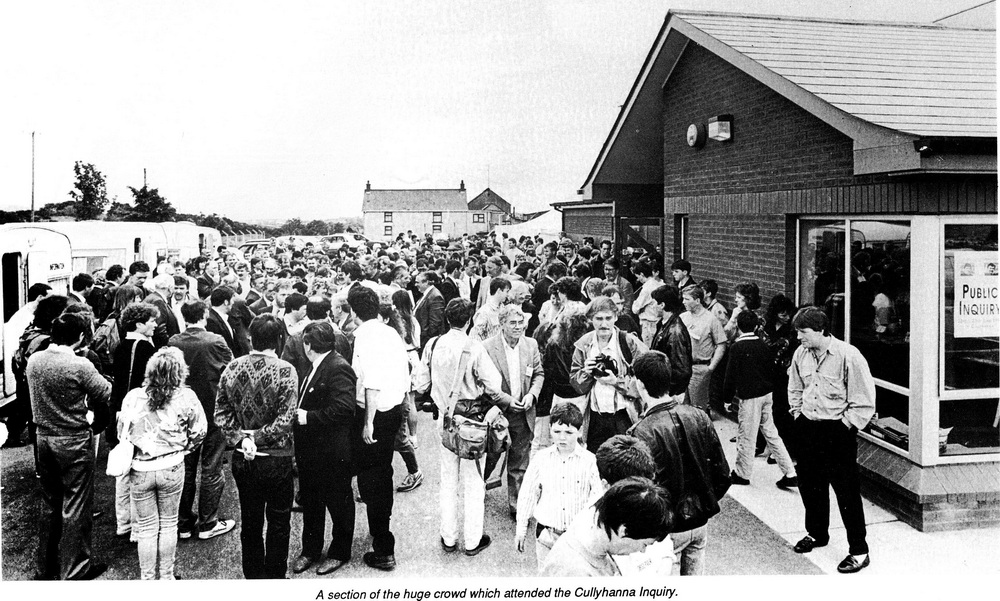
Unofficial public inquiry held in Cullyhanna, County Armagh, on 22–23 June 1991. The inquiry examined the killing of Fergal Caraher and the wounding of his brother Míceál Caraher by British Royal Marines on 30 December 1990.
This page presents the text of the 1991 report. Page images and the original printed volume remain with the source. A downloadable PDF of the full report can be added when the scan set is complete.
Cover design: Robert Ballagh. Photographs: Derek Speirs. Graphics: Irish Times Studio. Printed by O’Donoghue Print (Dublin). Report production team: Anne, Tina, Richard R. and Eamon.
Contents
- Foreword — Caitriona Ruane and Francis McNamee
- Introduction — T. Cullen
- Profile of Fergal Caraher
- Submissions at the Inquiry (Fr. Raymond Murray, Fr. Malachy Conlon, Margaret Caraher, Peter John Caraher, Committee on the Administration of Justice, and others)
- Submissions subsequently considered (Amnesty International, Colm Campbell, Irish Council for Civil Liberties, Britain and Ireland Human Rights Project, Irish National Caucus, United Campaign Against Plastic Bullets, U.S. Congressional Hearing)
- Appendices: Yellow Card instructions; killings by security forces since 1982; official correspondence
- Full verbatim text of the report (separate page).
Foreword
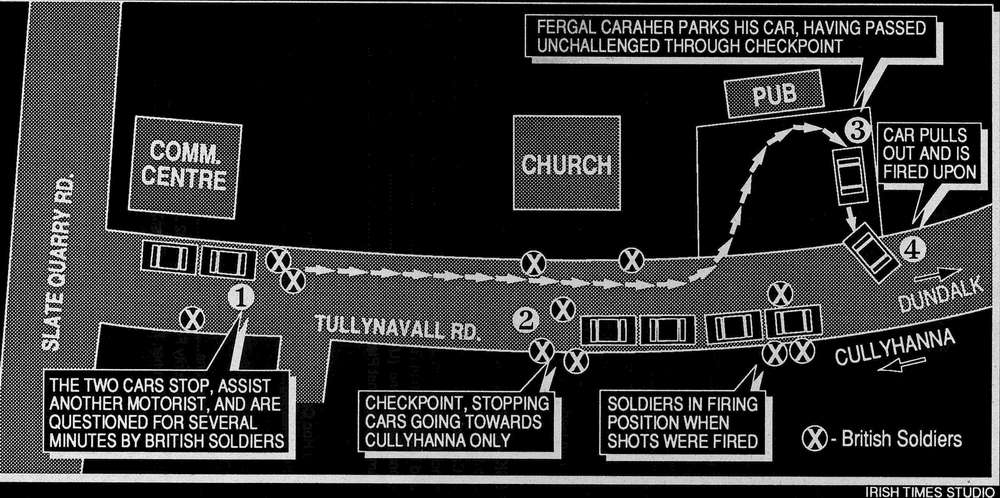
Fergal Caraher was shot dead by British troops and Míceál Caraher seriously wounded on 30 December 1990. The community in South Armagh were shocked as were people from all over Ireland. The shooting was condemned by people far and wide, many of them calling for an independent inquiry.
According to Amnesty International’s June 1991 report, 339 people had been shot dead by the security forces in Northern Ireland since 1969, many in disputed circumstances. Twenty-seven members of the security forces had been prosecuted; nineteen were found not guilty, one was found guilty of manslaughter and given a suspended sentence. Private Ian Thain was convicted of murder, given a life sentence, released after two years and three months, and reinstated in the British Army.
These statistics give rise to serious concern about the administration of justice in the North of Ireland and explain why many people are cynical about RUC investigations. It was precisely because of this that the Caraher family called for an independent public inquiry. As the authorities were unwilling to convene one, the community decided to take on the responsibility themselves.
At the first organising meeting in Cullyhanna the room was packed. International human rights organisations were contacted. Michael Mansfield QC agreed to act as chairman for the panel of jurists. Groups were written to all over Ireland, Europe and the United States and asked to send official observers. This is a report of the proceedings of the two-day inquiry. It includes submissions made by the family, expert witnesses, and the findings of the jurists.
Caitriona Ruane (Irish National Congress) and Francis McNamee (Cullyhanna Justice Group)
Introduction
There is a tragic irony in the fact that, as this report is being published, we are approaching the 20th anniversary of Bloody Sunday in Derry (30 January 1972) when 13 innocent people were mercilessly shot dead by British troops. Why is it necessary 20 years later for a family and a community to take on the role of a private Attorney General and attempt to uncover the truth and find justice when a member of the community has been brutally killed by the guns of British soldiers.
The shooting dead of Fergal Caraher was the trigger which set in motion a great communal reaction. The first step was to hold a public inquiry in Cullyhanna, Co. Armagh on 22/23 June 1991 and then to publish this report of that inquiry and related issues. The issues in this case are similar to those involving hundreds of other victims and their families.
Since 1982 and the John Stalker investigation, 68 people have been killed in circumstances giving rise to recurring claims that a “Shoot-To-Kill” policy persists in the North of Ireland. The statistics speak for themselves: since 1969 to the time of printing this report there have been 345 fatal shootings by the security forces in Northern Ireland. There are no known written or official orders to carry out such killings, but they are condoned by the secrecy and the lack of public scrutiny by the authorities.
Justice delayed is justice denied. All incidents involving deaths caused by the British Army or RUC by lethal force need to be treated even-handedly, quickly and in public, where all witnesses should be cross-examined in open court. Confidence in the judicial system will come about only when controversial killings like this one are subject to independent, impartial investigation.
T. Cullen, B.C.L., B.L., Inquiry Co-ordinator, Irish National Congress National Executive, November 1991
Profile of Fergal Caraher
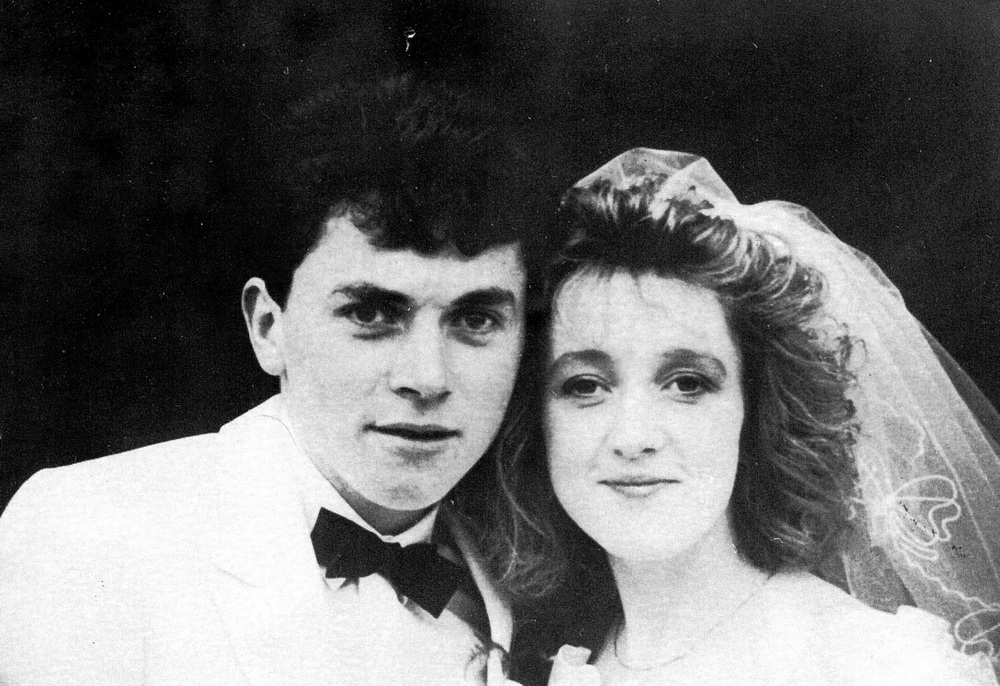
Fergal Caraher was shot dead by the British Army on 30 December 1990. He was 20 years of age when he was killed, married, with a one-year-old son, Brendan. He was the fifth eldest of a family of nine children born to Peter John and Mary Caraher of Cullyhanna. Peter John is a local farmer and Mary deputy headmistress in St. Patrick’s School, Cullyhanna.
Fergal, following the example of his parents, was committed to work within the community. He was a member of St. Patrick’s Youth Band, had played on the local Gaelic football school team, and played an active role in all the activities in his local community. He was a member of Sinn Féin. He went to St. Patrick’s primary school, Cullyhanna and St. Colman’s College, Newry. On leaving school he worked in Newry meat factory until an industrial injury forced him to leave. He was a very popular member of the local community, well liked by young and old. He had been married less than two years when he was killed.
Submissions at the Inquiry
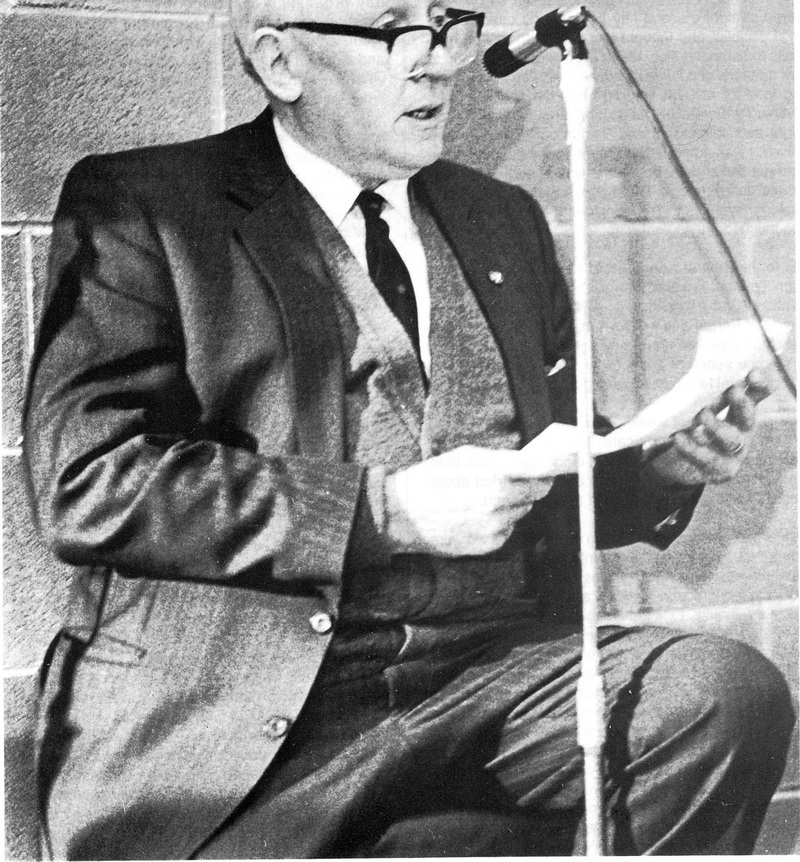
Fr. Raymond Murray — 23 June 1991
Amnesty International has just celebrated its thirtieth birthday. People involved in the campaign for human rights in Northern Ireland are grateful to them for their interest in the protection of citizens of the North from the illegal acts of those in charge of the law. There have been other reports on killings connected with the security forces. The British Government conducted a public inquiry under Lord Widgery into the shooting dead of 14 citizens by British Army paratroopers in Derry on 30 January 1972. The Association for Legal Justice conducted two international inquiries into the use of plastic bullets. In 1984 an International Lawyers’ Inquiry published its report on the lethal use of firearms by the security forces. The British Government ordered an inquiry into the shooting dead of six unarmed men and the wounding of another in County Armagh in 1982; there have been allegations that John Stalker was deliberately obstructed.
From the deaths of Samuel Devenney and John Gallagher in 1969 at the hands of the RUC to the shooting dead of three IRA men by the SAS in Tyrone on 3 June 1991 one can list some 150 direct administrative killings and scores of indirect killings manipulated by the British Intelligence system. Since the 1982 killings investigated by John Stalker, 67 civilians and paramilitaries have been shot dead in “Shoot-to-Kill” operations. Twenty of these were civilians and 47 paramilitaries, of whom only two were loyalists.
Only one British soldier has been sentenced to life imprisonment for the murder of a Catholic civilian — Private Ian Thain, who murdered a Belfast youth called “Kidso” Reilly. He was released after serving only two years and three months of his sentence and returned to his regiment. Amnesty International’s June 1991 report called for an independent inquiry which should look into the legislation and regulations governing the use of lethal force, as well as into the procedures used to investigate disputed incidents. The Government of the United Kingdom has constantly refused to do this.
Fr. Malachy Conlon — 23 June 1991
My brief is to outline the environment in which the killing of Fergal Caraher and the injury of Míceál Caraher took place, with particular reference to harassment by the British Army and RUC. Dr. Cahal Daly, Archbishop of Armagh, said: “Many responsible people are completely unconvinced by the account so far given by the British army. It is vitally important that the whole truth be established. There must be no question or suspicion of a security forces cover-up.”
It was in November that the Marines arrived in South Armagh and from the outset they claimed to have been sent in to clean out the area and from an early stage they boasted that they were “answerable to no-one.” Children were afraid to return home after a disco. Grown men and women were literally afraid to go about their normal business. I document cases of harassment, including one in which a soldier put a gun into a man’s mouth and another in which a man was beaten until he lost consciousness. Mr Seamus Mallon MP stated that since the killing of Fergal Caraher the level of fear and tension in South Armagh had reached a new level. A meeting with Brigadier Derek Woods and the commanding officer of the Marines took place on 14 January 1991. Assurances were given that cases would be investigated; the subsequent responses were unsatisfactory.
I without reservation condemn all violence, and feel that the violence of the institution, namely the RUC and the British army, is one of the sickest forms of violence and is one of the greatest recruitment agents for the paramilitaries.
Margaret Caraher — 23 June 1991
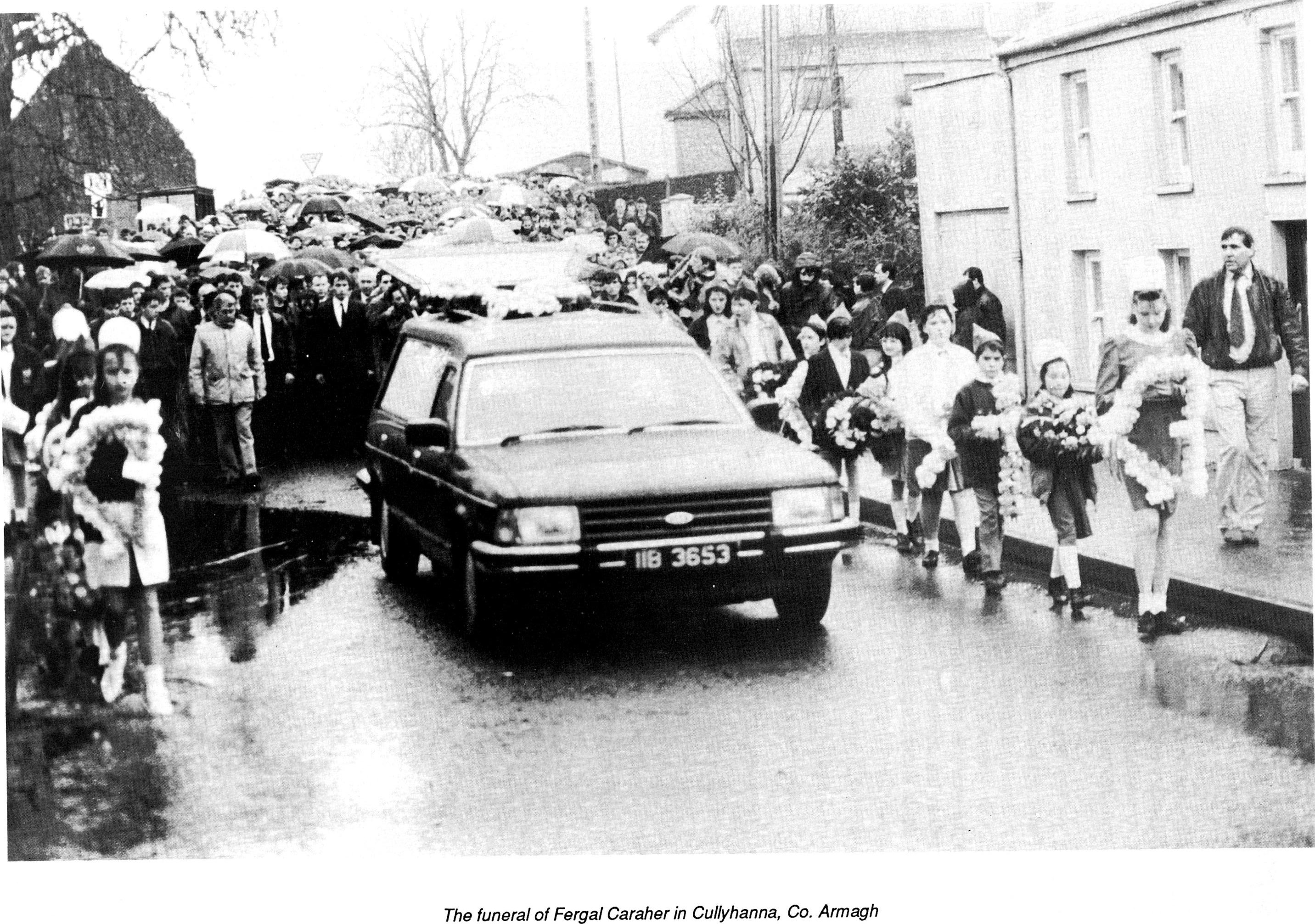
I was at home when my sister Loretta, Dr. Allen and my sister-in-law Maria came in. Loretta said she didn’t know how to say it so she would just come straight out and say it: “Fergal is dead.” I felt total disbelief. At the funeral I felt really proud of Fergal and what he meant to all these people. I felt a real sense of belonging to the community. We were all very worried about Míceál. We wanted him at least to pull through. It was accepted among the family that we were going to do something. We weren’t just going to let it go.
I went to one of the first meetings with people from the Irish National Congress in Dundalk. I felt encouraged by the support. At one particular meeting we were all in the meeting room stuffing 3,000 envelopes with information about the inquiry and it really lifted my spirits to see people believing in what we were doing. I feel that there was absolutely no justification for shooting Fergal. I feel angry, hurt, and appalled. I am left without a husband and my son Brendan without a father. I don’t want any other family to go through what we are going through. Fergal’s death isn’t forgotten. We are all proud of him, we miss him and we will do our utmost to see that justice is done.
Peter John Caraher — 23 June 1991
The month before Fergal was shot dead and Míceál wounded I noticed that there was a lot of harassment in the local area by the British Army. They were very aggressive, hostile, and unmannerly at checkpoints. Coming up towards Christmas they told different people in the area that they would shoot somebody before Christmas. In the middle of December a carload of local lads had their driving licences taken from them. They took them out of the car and said they wanted to get a good look at them in case they were some of the bastards they would have to shoot before they would leave. They told me themselves that they would shoot me in Cullyhanna before they go away.
When I went to see about my son down the road I was stopped by British soldiers and they wouldn’t let me go any further. One soldier told the other to train his gun at that “fucker’s head and if he moved blow him to fuck.” From the very beginning I was determined that we would get to the truth. When asked by journalists how long we would continue this quest I told them until I died or we got a satisfactory answer, whatever came first. The very next day Caitriona Ruane, Nora Comiskey and Thomas Cullen from the Irish National Congress came to the house. I was never contacted by the Police or Army or any of the authorities to let us know that Fergal was killed and Míceál wounded. Margaret and Brendan were never contacted either. It is a terrible indictment of any State that doesn’t inform you of a citizen’s death and especially when that death is caused by the State.
I feel very angry, first and foremost at the British Government for allowing these soldiers to do what they want in our community. I’m also very angry and saddened at the attitude of the Southern Government. In all of 63 years the only bandits I have ever met are the thugs who shot my two sons.
Submissions subsequently considered
Committee on the Administration of Justice
The CAJ submission lists deaths caused by RUC/British Army personnel in 1990 and 1991, including the Whiterock betting-shop killings (John McNeill, Eddie Hale, Peter Thompson), Martin Peake and Karen Reilly, Desmond Grew and Martin McCaughey, Alexander Patterson, the Cullyhanna shooting itself, Colum Marks, the Coagh ambush, Kevin McGovern, and Gerard McGinn. It notes the pattern of delayed inquests, soldiers not attending, and the House of Lords decision in McKerr that rules forbidding the calling of persons charged with an offence relating to the death were valid.
On Article 6 (the right to life), the CAJ states that the law on the use of force in section 3 of the Criminal Law Act (NI) 1967 is inadequate. The test should be whether force was absolutely necessary to preserve other human life, not whether it was reasonable in all the circumstances. Very few police officers or soldiers have been charged in connection with the 339 deaths at the hands of the security forces since 1969. Of these, 184 involved civilians with no connection to any paramilitary group.
Amnesty International
Amnesty International’s submission reiterates concerns about inadequate investigations of disputed killings. It notes that families are not properly informed of deaths, are often refused copies of autopsy reports, and in some cases have alleged harassment. The Caraher family was refused permission to arrange an independent forensic examination of the car. Current investigative procedures in Northern Ireland contravene the United Nations Principles on the Effective Prevention and Investigation of Extra-Legal, Arbitrary and Summary Executions. Amnesty continues to call for an independent and impartial judicial inquiry into disputed killings by the security forces.
Colm Campbell
Colm Campbell’s submission addresses the gap between national and international legal standards on the use of lethal force, the problems of the inquest process in Northern Ireland (no verdicts of unlawful killing, soldiers not compellable, long delays), and current trends in security policy following the Anglo-Irish Agreement. He recommends that coroners open and adjourn inquests pending prosecution decisions, that the prohibition on compelling suspected persons be abolished, and that the English system of verdicts including “unlawful killing” be introduced.
Irish Council for Civil Liberties
The ICCL focuses on the erosion of rule-of-law values in relation to lethal force by the security forces. It argues that the present “reasonable use of force” standard is inadequate and that the law should be reformed to a test of absolute necessity. It notes that investigations by the RUC of its own members or of the army lack independence, that inquest procedures have been restricted, and that there is compelling need for an inquiry into collusion between members of the security forces and loyalist paramilitaries. The Stevens inquiry had a narrow focus; 59 people were charged or reported, but none were members of the security forces.
Britain and Ireland Human Rights Project
The Project congratulates the Caraher family, the Irish National Congress, and the Cullyhanna Justice Group on organising the inquiry. It examines the terms of reference in detail, highlighting the inadequacy of coroners’ inquests, the withholding of soldiers’ identities, the denial of prompt access to autopsy reports, and the gap between domestic law and international standards (ECHR Article 2, UN Principles, Basic Principles on the Use of Force and Firearms). It recommends that the report be sent to the UN Special Rapporteur on Summary or Arbitrary Executions.
Irish National Caucus, Inc.
Rita Mullan, Executive Director, recommends that all documentation and conclusions be forwarded to Mr. Amos Wako, Center for Human Rights, UN Office at Geneva, under the Individual Complaints Procedure of the Optional Protocol to the Convention on Summary and Arbitrary Execution. She quotes Peter John Caraher: “This inquiry will not bring Fergal back to us, nor will it ease the heart break and sorrow which we still feel. But we hope that it will help to prevent similar murders of Irish people by British soldiers in the future.”
United Campaign Against Plastic Bullets
The Campaign notes that 17 people have been murdered by plastic and rubber bullets, eight of them children. It draws parallels with the Cullyhanna case: the operation of a “Shoot to Kill” policy, the security forces not being subject to the rule of law, the denial of justice to families, harassment of relatives and witnesses, the immediate misleading publicity campaign, and the denial of access to information and evidence.
U.S. Congressional Hearing — September 1991
At a packed hearing on 17 September 1991, cosponsored by the Ad Hoc Congressional Human Rights Caucus and the Congressional Committee for Irish Affairs, members of Congress heard evidence that British troops frequently use lethal force without cause. Thomas Manton (D-NY) stated: “The Carahers present the most compelling case that can be made for the Hearing we are holding today.” Joseph P. Kennedy II (D-MA) said: “Whether a shoot-to-kill policy exists by official decree or not is academic. For by its silence, secrecy and willingness to tolerate corrupt practices the government condones killings that can only be motivated by an intent to shoot-to-kill.” Senators Christopher Dodd and Alan Cranston distributed an open letter requesting President Bush’s personal intervention.
Appendices
Appendix A — Instructions for Opening Fire in Northern Ireland (Restricted Army Code No. 70771)
General rules: use the minimum force necessary; firearms must only be used as a last resort; the weapon must always be made safe. A challenge must be given before opening fire unless to do so would increase the risk of death or grave injury, or you or others are being engaged by terrorists. You may only open fire against a person if he is committing or about to commit an act likely to endanger life and there is no other way to prevent the danger, or if you know that he has just killed or injured any person by such means and he does not surrender if challenged and there is no other way to make an arrest. Fire only aimed shots; fire no more rounds than are necessary; take all reasonable precautions not to injure anyone other than the target.
Appendix B — Killings by British Security Forces since November 1982
A chronological list of incidents from the November 1982 HMSU killings (Sean Burns, Eugene Toman, Gervaise McKerr; Michael Tighe; Seamus Grew and Roddy Carroll) through Loughgall (May 1987), Gibraltar (March 1988), the Coagh ambush (June 1991), and the Cullyhanna shooting itself (30 December 1990). The list records whether the deceased were armed or unarmed, whether prosecutions followed, and the status of inquests. In the large majority of cases no prosecutions were brought and soldiers did not give oral evidence at inquests.
Appendix C — Official correspondence
Replies from the Ministry of Defence, the RUC, the Standing Advisory Commission on Human Rights, and the Civil Adviser to the GOC declining to contribute to the unofficial inquiry. Correspondence with HM Coroner for South Down (J. Daniel Thompson) showing that the autopsy report on Fergal Caraher was withheld until the conclusion of the inquest, the date of which the coroner was “unable presently to anticipate.” RUC correspondence refusing or deferring an independent forensic examination of the vehicle, declining to release the names and addresses of the soldiers involved, and stating that statements and reports taken for the criminal investigation could not be made available for civil proceedings until the completion of any criminal trial or inquest. Assistant Chief Constable W. G. Monahan confirmed that the investigation was well advanced and that papers would be sent to the DPP shortly, but that the Chief Constable’s recommendations to the DPP were confidential and would not be notified.
Full text compiled from the 1991 printed report. Minor OCR corrections applied. Original page images and the printed volume remain with the source.