Irish royal sites
Fenian
Fenian is an English form of Irish fianaigecht / Fianna. In the early literature a fían is a war-band; a fénnid is a man of that band. The stories gathered around Fionn mac Cumhaill and the Fianna Éireann — hunting, fosterage, the otherworld, the defence of the coast — are the Fenian Cycle (an Fhiannaíocht), one of the four cycles of medieval Irish narrative. The name is older than any nineteenth-century party.
When Irishmen in America in 1858 styled themselves the Fenian Brotherhood, they took that literary name, not a new coinage. The Irish Republican Brotherhood used the same root. This site’s title sits in that American usage: a research shelf, not the 1858 organisation and not Pennsylvania corporation 808740.
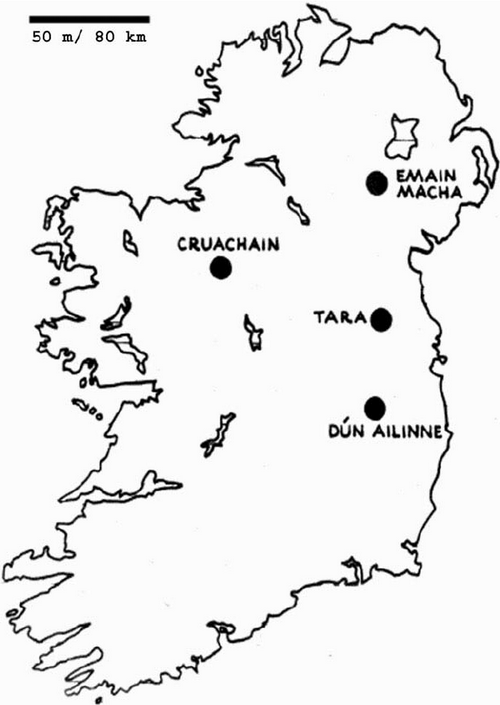
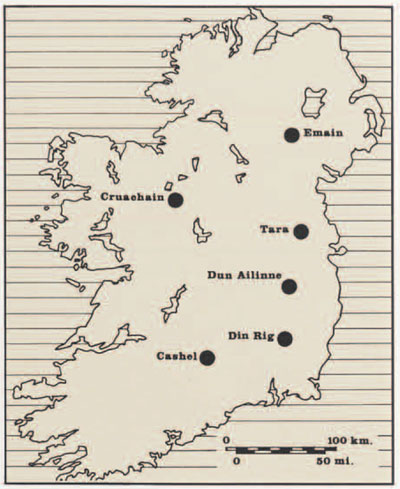
The four classic “royal sites” of the late prehistoric / early medieval landscape are Tara (Temair), Navan Fort (Emain Macha), Rathcroghan (Cruachain), and Knockaulin (Dún Ailinne). The papers below are a working library of excavation reports, place-name notes, and myth-and-landscape essays gathered because they are hard to find in one place. Rights remain with the authors and publishers.
Knockaulin  - Dun Ailinne of the Laighin
Navan Fort  - Emhain Macha of the Ulaidh
Rathcroghan - Cruachain of the Connachta
Tara        - The most sacred to all
All
- 2006 Johnston, S. Revisiting the Irish royal sites, Emania 20
- An Irish Historical Tract Dated A.D. 721
- ARCHAEOLOGY AND MYTH
- Data Structure Report Dorsey
- Early Irish Population-Groups
- Excavations on a Mound at Gransha, County Down
- Inauguration Rites Of Rulers In Ireland And Carinthia
- INAUGURATION RITES
- Indo-European Origins, and the Domestication of the Horse
- Ireland in the Iron Age A Basket Case
- Ireland in the Iron Age, A Basket Case
- Ireland in the Iron Age
- Lough Lugh, Uisneach
- Mocu, Maccu
- Motes and Mounds at Royal Sites in Ireland
- Muiredach's Cross, Dextra Dei and Divine Bulls
- Ptolemy's Map of Ireland
- Recycled Ringforts
- Reflections on the Making of a 'Royal Site' in Early Ireland
- Revisiting the Irish Royal Sites
- Settlement and Disease
- Some correlations between henge enclosures and oenach sites
- The Archaeology of the Irish Dreamtime
- The Descent of the Gods
- The Early Place-Names of County Armagh
- The Edinburgh Text of Mesca Ulad
- The Liminal Boundary An Analysis of the Sacral Potency of the Ditch at Ráith na Ríg
- The Origin of the Three Collas and the Fall of Emain
- The Origins of the Irish
- The Sacred Landscape of ANCIEN IRELAND
- The Sacred Landscape of Ancient Ireland
- Time Perspective and Proto-Indo-European Culture
- Time, Memory, and the Boyne Necropolis
- Twenty-first century clouds over Indo-European homelands
- Who are the Fir Bolg
- Who are the Gaeil
Knockaulin
- A Geophysical Survey at Dún Ailinne, County Kildare, Ireland
- Dun Allen - Pam Crabtree et al
- Dún Ailinne - Bernard Wailes
- Excavations at Dun Ailinne, Co. Kildare 1968-9 Interim Report
- Excavations at Dun Ailinne, County Kildare
Navan
- Ann hamlin - Emain Macha - Navan Fort
- Archaeological Evaluation Of The Inaugural Landscape Of Crew Hill
- Dal Fiatach - Ecclesiastic Antiquities
- Data Structure Report Dorsey
- Data Structure Report Navan Fort
- Data Structure Report- Navan Fort, Chris Lynn
- Dating Navan Fort
- Diocese of Down - Ecclesiastic Antiquities
- Emain Macha A monument for all myths Mallory
- Emain Macha Ann Hamlin
- Emain Macha Navan Fort
- Excavations at Navan Fort
- Haugheys Fort Machas Other Twin
- Ireland in the Iron Age A Basket Case
- Macha And The Invention Of Myth
- Navan Fort A Monument for all Myths
- Navan Fort Home of Gods and Goddesses
- Navan Fort Legendary Capital of Prehistoric Ulster
- Navan Fort Mallory
- Navan Fort—Legendary Capital of Prehistoric Ulster
- navanfortengNIEA
- Recent excavations and speculations on the Navan complex
- Reweaving the Tapestry of Ancient Ulster JSTOR
- Reweaving the Tapestry of Ancient Ulster
- The Archaeology Of Navan Helen Steele
- The Archaeology of the Irish Dreamtime
- The Dal Fiatach
- The Founding of Emain Macha 1
- The Founding of Emain Macha 2
- The Origin of the Three Collas and the Fall of Emain
- The Origins of the Irish
Rathcroghan
- A Survey of the Royal Site of Cruachain in Connacht
- ARCHAEOLOGY AND MYTH a consideration of the ancient royal site of Rathcroghan
- John Waddell 2009 rathcroghan
- Rathcroghan A Royal Site in Connacht
- Rathcroghan, Co. Roscommon
- The Innermost Secrets of Rathcroghan Mound
- THE PITFIELDS OF RATHCROGHAN
Tara
- Colonisation under Early Kings of Tara
- Composing Tara, the Grand Opera of Irish Pre-History
- EARLY HISTORIC ROUTEWAY
- Tara, a Renowned Fortress
- Tara, Co. Meath A Guide to the Ceremonial Complex
- The Liminal Boundary An Analysis of the Sacral Potency of the Ditch at Ráith na Ríg
- The Mound of the Hostages
- The Northern Road from Tara