
Irish Republican Army Part 01 · p.66
Back to search
·
About this set
·
Irish Republican Army Part 01
·
All files
Transcript
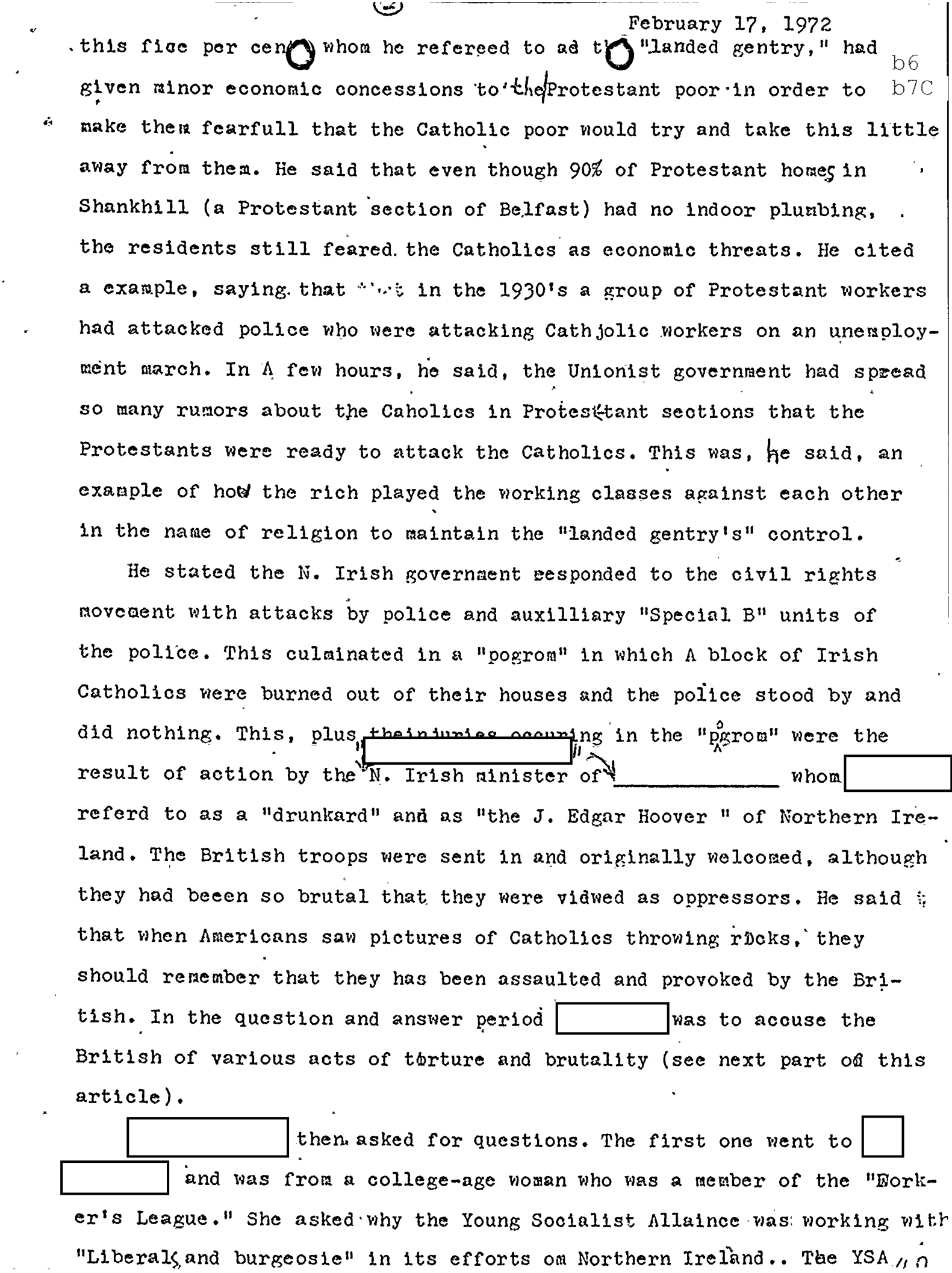
February 17, 1972
.this fiac por ceng
mhom he refereed to ad t
"landed gentry," had
b6
given minor economic concessions to'thqProtestant poor·in order to b7C
nake theα fcarfull that the Catholic poor nould try and take this little
away fron them. He said that even though 9o% of Protestant homes in
Shankhiil (a Protestant section of Belfast) had no indoor pluabing,
the residents still feared. the Catholics as cconomic threats. He cited
a exanple, saying. that "',,: in the l930's a group of Protestant workers
had attacked police who were attacking Cathjolic norkers on an unerploy-
ment march. In A fen hours, he said, the Unionist government had spzead
so many rumors about the Caholics in Protes&tant sections that the
Protestants were ready to attack the Catholics. This was, he said, an
in the nane of religion to maintain the "landed gentry's" control.
He stated the N. Irish governaent pesponded to the civil rights
movcaent with attacks by police and auxilliary "Special B" units of
the police. This culainated in a "pogrom" in which A block of Irish
Catholics nere burned out of their houses and the police stood by and
did nothing. This, plus,theiniuriea ooouring in the u
result of action by the%N. Irish ninister or4
whom
land. The British troops were sent in and originally welconed, although
they had becen so brutal that they were vidwed as oppressors. He said é
that when Americans saw pictures of Catholics throning rDcks, they
should renember that they has been assaulted and provoked by the Bri-
tish. In the question and answer period
was to accuse the
British of various acts of tbrture and brutality (see next part od this
article).
then. asked for auestions. The first one went to
and was from α college-age noman who was a member of the "Eork-
er's League." She asked·why the Young Socialist Allaince was: norking vith
"Liberalsand burgeosie" in its efforts ou Northern Ireland.. Tbe YSA /,